About ANSRTM(pat.pend)
Back to HomeANSR™
Philosophy
不完全なゲームを、データで戦い、
好敵手と出会うための思想
不完全ゲームを、知性で戦う
ゴルフはミスが前提のスポーツ。感覚ではなく、データに基づく判断と戦略で不完全さを乗りこなす
1打の座標を、集めて残す
スコアという数字ではなく、1打1打のドット(座標)を集積し、あなただけのゴルフの時間軸を作る
少し上の好敵手と、戦える自分を作る
自分を正確に測り、最高の対戦相手と出会うためのデータ基盤を構築する。それがPhase 1
ANSR Ecosystem Overview
Why WITB (club data) and the 8-Level system come first. Every data input is the starting point of the improvement loop.
The Philosophy — Why ANSR
From intuition-based golf to fact-and-verification-based golf. Not recording for recording's sake, but recording for improvement — rooted in the recognition that golf is fundamentally an "imperfect game."
Breaking Free from Intuition Dependence
Most golfers reflect after a round: "My driver was good today" or "My approach was terrible." But this reflection has a fatal flaw: only the memorable shots are remembered, while the full picture of actual performance remains invisible.
"My putting was off"
"I think my driver was good"
→ Can't identify what went wrong
→ Repeat the same mistakes next round
→ Practice direction determined by "mood"
"Irons at 150-170y scatter right"
"3-putt rate at 22%, improved from last time"
→ Can identify miss patterns
→ Reflected in next strategy and practice
→ Improvement runs as a "system"
Try recalling "what went wrong" in your last round. Your answer is probably intuition-based. That's natural. What matters is whether you have the means to verify if that intuition is correct. ANSR is the tool for that.
Golf Is an "Imperfect Game"
Before understanding the Target Log philosophy, you must first correctly recognize the true nature of golf as a sport.
Golf is an "imperfect game." This is the foundation of ANSR's design philosophy.
An imperfect game is one where players structurally cannot produce perfect results every time, no matter how skilled they become. Even professional golfers rarely land the ball exactly where they aimed. Every shot inevitably has "dispersion."
scatter in an elliptical pattern. This is the reality of "imperfection."
Mistakes "happen" — they're not something to "eliminate"
In perfect games (chess, esports), mistakes result from insufficient skill and can approach "zero" with practice. But in golf, even the world's best players maintain only ~70% fairway hit rate. Mistakes occur structurally. Therefore, the question is not "how to eliminate mistakes" but "how to know your miss tendencies and have a strategy to minimize damage when misses happen."
"The best single shot" doesn't decide the match — "the accumulation of best decisions" does
In an imperfect game, each shot's result contains randomness. A super shot may be followed by a miss on the next hole. What matters isn't individual shot results, but the sum quality of ~80 decisions across 18 holes × 4-5 shots. That's why you need to record both "where you aimed (intent)" and "where it went (result)." Judging results alone cannot evaluate decision quality.
Without knowing your own "dispersion," you can't build a proper strategy
The pin is cut on the right edge. If your shots tend to scatter right, aiming at the pin itself becomes a high-risk decision. Conversely, a player who tends to miss left can aim directly at the pin. Precisely understanding your dispersion pattern determines strategic accuracy. This is why WITB and level settings define "your weapon's performance."
Don't aim for perfection. Accumulate the best decisions based on the premise of imperfection.
That is "how to fight an imperfect game" — and the reason ANSR was designed.
Think mistakes will disappear once you get better? Even PGA Tour top players maintain only ~70% fairway hit rate. Mistakes occur structurally at the highest level. What matters isn't eliminating mistakes to zero, but knowing your miss tendencies and managing them. This dispersion concept connects directly to WITB and level settings.
Self-Awareness Resolution — The Biggest Problem Is "Not Knowing Yourself"
That golf is an imperfect game — this is a structural fact.
But there's an even more serious problem. 99% of golfers cannot accurately assess their own status (level).
You know your score. You know your handicap. But "where does my tee shot accuracy fall on an 8-level scale?" "What level is my approach distance control?" "What's my putting weakness?" — virtually no golfer has this kind of skill-specific resolution.
When your current position is unclear, the concept of "growth" itself becomes blurry — because you can't define where you're going from where. As a result, your improvement direction gets pulled into two traps.
Hit OB / 3-putted
Missed from 30cm / Shanked
Emotional Impact → High
Club selection accuracy at 150y+
2nd shot tendencies on Par 4s / Approach success rate by distance
Course management decision patterns
Structural scoring patterns → Major score impact
Golfers' attention focuses only on "visible events" above the waterline. OBs and shanks are emotionally impactful and memorable. But what structurally drives scores up are the "mundane but frequent miss patterns" below the waterline.
Low self-awareness resolution means not seeing what's below the surface.
ANSR's 8-level system exists precisely to solve this problem. Decomposing your golf into multiple skill axes and quantitatively grasping your current position on each — that's what "raising resolution" means.
"I'm roughly a 95-scorer"
→ Don't know what's weak
→ Practice is "general"
→ Improvement is slow or non-existent
→ Long irons are the bottleneck
→ Room for growth in course strategy
→ Putting is fine, maintain
→ Improvement priorities are clear
In the left state, you can't determine "what to practice." In the right state, you can judge that "raising long iron accuracy from Lv.3 to Lv.5" and "raising course strategy from Lv.4 to Lv.5" have the biggest score impact. Putting is already at Lv.7, so spending time there is inefficient.
Feedback Delay
A golf round takes 4-5 hours, yielding about 80 data points. Round opportunities are only 1-2 times per week. The small sample size and long feedback time make "your tendencies" hard to see. Range shots differ from course conditions, so range results can't be directly applied.
The Emotional Filter
Humans overvalue "dramatic events" and undervalue "mundane but frequent events" (availability heuristic). Water hazards and OBs are intensely memorable, but the fact that "my 150y iron drifts 8y right on average" never reaches awareness. Emotion becomes a cognitive filter, blocking objective self-assessment.
Absence of Reference Points
"What level is my approach?" — without a benchmark, you can't answer. You might compare with playing partners, but that's just a relative impression. Without an absolute benchmark (Levels 1-8), you can't say "I am here." ANSR's 8 levels provide this benchmark.
Those who don't know where they are can't decide where to go.
It's the same as walking without a map.
Raising resolution means getting a map of your own golf.
Ask yourself: "What was the worst thing in your last round?" — OB or 3-putts probably come to mind. Now: "Which direction does your iron typically scatter?" — Can you answer? If not, that's low self-awareness resolution. It starts with defining your current position "in numbers" using ANSR's 8-level system.
Strokes Gained and the "Next Level" Benchmark
As stated in §1-3, knowing your level is important. But knowing your level alone isn't enough.
What matters is knowing the specific gap between "current you" and "next you." This is where Strokes Gained enters — and how ANSR redefines it.
Strokes Gained (SG), proposed by Columbia University's Professor Mark Broadie, revolutionized golf analytics. Traditional statistics (fairway hit rate, GIR, average putts) merely tallied shot "results" individually. SG fundamentally changed this.
SG was groundbreaking. But it has one major assumption.
Mark Broadie's original SG uses PGA Tour average performance as the benchmark. Every shot is compared to "how many shots would a PGA Tour player take to hole out from this situation, on average?"
PGA Tour average: within 20ft of pin
Your result: off green (40ft)
→ SG: -0.8
"0.8 strokes worse than PGA Tour"
→ But isn't that obvious?
ANSR's SG sets the benchmark not to "PGA Tour" but to "your next level up." For 80s players, Single is the benchmark. For Under 5, Scratch is the benchmark.
Lv.3 (Single) benchmark: 65% GIR, avg within 30ft
Your result: 50% GIR, avg 38ft
→ SG vs Next Level: -0.3
"To reach Single level, close this 0.3-stroke gap"
→ A specific, achievable goal
Result: Can't understand advanced problem sets because fundamentals aren't solid. Motivation drops. Feels "impossible for me."
Core problem: The gap to Tokyo U spans "50+ areas." Don't know where to start. The gap is too large to feel any improvement.
Result: Conquering "quadratic functions" and "relative pronouns" — just 2 areas — gets there. Specific, actionable, short-term results.
Same in golf: Going from Lv.2 (80s) to Lv.3 (Single) might only require "improving approach accuracy within 100y" and "reducing decision errors on Par 4s." No need to aim for World Ranker standards.
Combining ANSR's 8-level system with SG creates the following structure.
"Minimizing the Gap" Accelerates Growth
When Lv.2 (80s) compares to Lv.8 (World Ranker), the gap is massive and omnidirectional — impossible to prioritize. But the gap to Lv.3 (Single) narrows to 2-3 specific actions like "increase approach GIR by 15%" or "improve Par 4 scoring by 0.3 strokes." Fewer items to improve means focus. Focus produces results. Results sustain motivation.
As Your Level Rises, the Benchmark Rises Automatically
Once you achieve Lv.2 (80s) → Lv.3 (Single), the next benchmark automatically becomes Lv.4 (Under 5). The same framework of "SG gap to next level" keeps the improvement loop running forever. The imperfect game strategy from §1-2 — "don't aim for perfection, move toward the next best" — implemented as a system.
"What to Do" Differs by Level
For Lv.1 (90s) → Lv.2 (80s), the priority might be "reducing big mistakes (OB, water)." But for Lv.4 (Under 5) → Lv.5 (Scratch), the challenge might be "improving iron accuracy at 150-180y." Same "improve irons," but the required precision, approach, and practice menu differ completely by level. Without a benchmark, you can't write a prescription.
Look at just one step above.
Looking nine steps up only paralyzes.
But one step — that's within reach of today's practice.
Who do you usually compare your golf to? Pros? Skilled friends? YouTube coaches? Can you say "specifically which areas to improve by how much to catch up?" If not, it's because the benchmark is too far away. Check your position on ANSR's 8 levels and look at the gap to one level up. You'll be surprised how small and specific that gap actually is.
The Target Log Philosophy
Golf is an imperfect game (§1-2), golfers' self-awareness resolution is low (§1-3), and the gap to "the next level" is the guide for improvement (§1-4).
When these three facts align, what to record and how becomes clear.
Every shot has an "intent (target)." And a "result (fact)."
Recording these two separately and analyzing their gap is ANSR's core philosophy — Target Log.
Most score management apps only record "results." Did it hit the fairway? Did it reach the green? How many putts? But in an imperfect game, results alone cannot evaluate decision quality.
→ Only know "I missed"
→ Unclear what to improve
Intent: Green center-left
Result: Right bunker
→ 20y off to the right
→ Can verify if same pattern appears on other holes
If you aimed at green center and hit the right bunker, that's a 20y right miss. But if you aimed directly at the pin (right edge) and hit the right bunker, it's only a 5y miss. Without recording intent, you can't even correctly measure the size of a miss.
Target → Result → Gap → Strategy This cycle turns improvement into a "system."
It might seem tedious, but try the actual Target Log input screen first. It's designed for minimum taps. Starting with just a practice round or half round is fine. You don't need to record perfectly. Just trying it once is where everything begins.
"Can You Commit?" — The Philosophy of Decision Commitment
Target Log records "what you aimed at (intent)" and "where it went (result)." But ANSR records one more often-overlooked dimension: "Did you commit to that choice?"
ANSR has a built-in "Mental Assessment" for each hole review. After recording focus, confidence, and emotional state, it asks one final question:
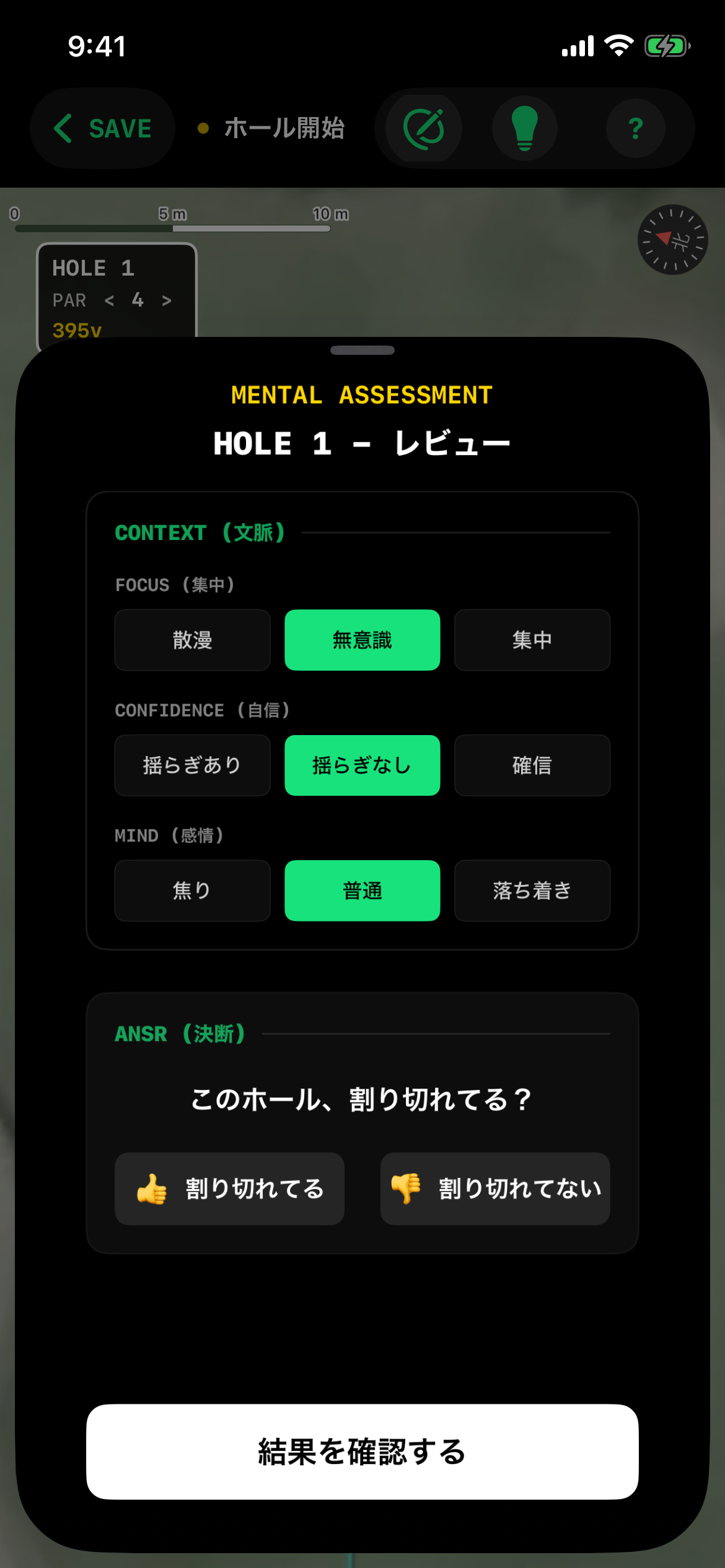
This isn't a mere mood log.
It's ANSR's core question about the quality of your decisions as a golfer.
Choosing "committed" declares: "I chose based on strategy and committed to that choice."
Choosing "not committed" honestly acknowledges: "I didn't clarify my choice, or I swung with doubt."
Neither is "right." But answering this question itself changes the quality of your decisions on the next hole.
You had a strategy. Based on that strategy, you chose a target, chose a club, and swung. Regardless of the result, your decision process is complete.
If the result was bad, the Next Action is clear: "revise the strategy." If good, you can verify: "this decision was correct."
Commitment means accepting the self that chose.
"Kinda aimed here." "Wasn't sure but swung anyway." "Actually wanted a different club." — A state of unclear choice.
Good results don't reveal why. Bad results don't reveal what to fix.
Without a choice, there's nothing to verify or improve.
The meaning of a shot changes dramatically based on the combination of "commitment" and "result."
The best shot.
Chose based on strategy, committed, and the result was good. This shot's process can be recorded as a "pattern to reproduce." Success is preserved in a verifiable form.
A learning shot.
The decision process was sound, but results didn't follow. This always happens in an imperfect game. The question is "was the strategy wrong, or was execution lacking?" Data enables verification. This is also a valuable dot.
The most dangerous shot.
Swung with doubt, but the result was good. Most golfers remember this as "success." But with unclear choice, it's not reproducible. Risk of mistaking "lucky" for "skilled." Without data, this misperception never gets corrected.
The hardest shot to improve.
Unclear choice, bad result. Can't identify what caused it or what to change. But recognizing "I wasn't committed" means you're already at the entrance of improvement. Start by committing next time.
ANSR's stance is clear.
Why "Decision," Not "Mental"
In typical golf apps, mental recording tends to be mood logs like "were you relaxed" or "did you feel pressure." ANSR's Mental Assessment is different. After recording three Context dimensions — Focus, Confidence, Mind (emotion) — it asks the final ANSR (Decision): "Can you commit?" Context is situation awareness. Decision is action choice on top of that. This structure separates "mood logging" from "decision logging."
What Becomes Visible When "Commitment" Data Accumulates
After 10 rounds of "commitment data," patterns emerge. "Commitment drops in back nine." "Tendency to not commit on Par 3s." "Commitment decreases on windy days." These aren't technical problems — they're decision process problems. Technical practice won't fix them. Clearer strategy and mental routine construction will. Without data, these issues are forever dismissed as "somehow mentally weak."
"Committed" means accepting the self that chose.
The imperfect game decides the result.
But the choice — that's always the golfer's to make.
Think of a hole in your last round where you "weren't committed." You probably have one in mind. Would the result have changed if you'd had a clear strategy? The answer might be "I don't know." But that's exactly the point — without a strategy, you can't even evaluate the result. That's why having a strategy, committing to choices, and keeping records matters.
The ANSR Ecosystem — How Data Flows and Returns
From §1-1 through §1-6, we've covered "why data is needed," "what to record," and "how to decide." Here, we overview when, where, and how all ANSR modules work together. ANSR isn't a single-function app. It's an ecosystem where multiple modules form one improvement loop.
PLAN / Course Strategy
For the next day's round, cross-reference the course hole layout with your WITB data to build hole-by-hole strategy. "This Par 4: driver to 230y fairway left side, 2nd shot 8-iron to green center" — design these intentions in advance. If previous Analyze data exists, corrections based on past failure patterns are incorporated here.
MEMO — Print Your Strategy PDF
Export your PLAN strategy as PDF and print it to bring to the course. No need to operate your smartphone during play. 18 holes of strategy condensed onto a single sheet. Check the paper before stepping onto the tee: "What was my strategy for this hole?" This becomes part of your pre-shot routine.
LOG — Shot-by-Shot Fact Recording
After the round, input shot-by-shot data. Target, result, club selection, Mental Assessment (including §1-6 "commitment").
A critical distinction here: "Remembering" and "recording" are different. Memory distorts with each passing hole, emotional filters engage, and after 4 hours, more than half becomes inaccurate. Records preserve facts as they are. LOG is the device that converts "memory" into "record." That's why you COMMIT (finalize) as soon as possible after play.
Analyze — Data Verification & Gap Analysis
Auto-analyze accumulated LOG data to get a bird's-eye view of your golf. What becomes visible here is the "below the waterline" from §1-3 — patterns, tendencies, and improvement points that intuition never noticed. Analyze results flow back in three directions.
Analyze → PLAN (Next Strategy Revision)
"Attacking too aggressively on Par 5 2nd shots." "One club wrong on back-nine Par 3s." These analysis results feed directly into next PLAN. Data-based strategy revision — not intuition — directly drives score improvement.
Analyze → Level Setting (Recommendation)
Levels aren't set manually. Analyze recommends your current level based on accumulated data. After 5 rounds, assessments like "tee shots at Lv.3 equivalent, approach at Lv.2 equivalent" are automatically presented. The "SG gap to next level" from §1-4 is also based on this recommended level.
Analyze → WITB (Club Data Calibration)
"Registered 7-iron distance is 160y, but actual data average is 152y" — Analyze visualizes this discrepancy. Calibrating WITB values with real data improves club selection accuracy in future PLANs. Keep your arsenal's performance data always current.
WITB (What's In The Bag) plays an independent role within the ecosystem.
ANSR's Share is fundamentally different from typical "post results to social media" features.
Content sharing evolved: Blog (long text) → Video (footage) → Shorts (clips). ANSR proposes what comes next — "sharing meaningful coordinates (dots)."
Share has two functional meanings: Recognition (coaches and teams grasp a player's current state through data) and Diffusion (golfers sharing "meaningful shots" — a new form of communication). Qualitatively different from "score bragging" or "nice shot videos," data-backed golf dialogue is born here.
Define tools with WITB, build strategy with PLAN, bring MEMO to the course,
record facts with LOG, get the overview with Analyze, calibrate level and WITB.
Then Share sends a single shot's coordinate out to the world.
This circulation is ANSR's full picture — all modules exist within one loop.
You don't need to master everything at once. The first step is just WITB registration → 1 round of LOG → look at Analyze once. Experience this minimum loop once, and the importance of PLAN, convenience of MEMO, and fun of Share will naturally become clear. Start with just one round.
Collecting Dots — The Story Told by Accumulated Shots
Until now, we've logically explained "why data is needed." But ANSR's true value lies beyond the data.
The Meaning of Recording Shots, Not Scores
The scorecard reads "5." Bogey. That's it.
But within that "5" lies the solid feel of a tee shot finding the fairway. The moment you first hit a green from 150y. The frustration of a 3-putt. A score crushes every shot's story into a single number.
What ANSR records isn't a score. It's each shot itself.
Every golfer has moments after a round of "if only that one shot..." But as data accumulates, the perspective can change.
Player's impression: "Couldn't get it close enough. Wanted it closer"
Moreover, even at Single level, 8ft from 30y is a standard result.
But the data shows it was a personal distance record for this club.
Frustrating, but 3 months ago the average at this distance was "20y off green."
Growth confirmed in numbers.
Steve Jobs said "Connecting the Dots." Look backward, and dots connect to form a line.
ANSR's philosophy is slightly different. Collecting Dots — the act of "collecting" dots itself has meaning.
In the world of Go, there's a concept called "the divine move." Over thousands of years, players accumulated move after move, their collection preserved as game records, from which the next generation learned and advanced further. One player's move becomes a link in a chain connecting all past players to all future players.
Golf is the same.
The shot you hit today stands on the accumulation of "past you." And that shot's data becomes the foundation for "future you" to strategize, decide, and grow. Today's shot builds tomorrow's golfer.
But behind that number lie dozens of decisions and dozens of results.
ANSR records each shot, collects them, lines them up on a timeline.
What emerges is your golf story, and yours alone.
Data from shots your past self hit
supports your future self's best decisions.
Collecting Dots. Building Your Story.
Do you have an "unforgettable shot?" You probably do. But the data — how many yards, what club, where you aimed, where it went — does it still exist? Probably not. With ANSR, that shot lives forever as data. And becomes a solid foundation for your future improvement.
Thought Drills — Consider the Meaning of Each Shot
Exercises to "use your own head" with everything covered so far. There isn't just one right answer. What matters is being able to articulate "why you judged that way."
Is This Shot a "Miss"? — Redefining What a Shot Means
Remaining 35y, pin is back-right of green. Bunker to the right.
Player is Lv.2 (80s). Approach tends to miss left.
Target: Center of green
Result: Left edge of green, 12m from pin
Player's impression: "Couldn't get close at all. Should have been more aggressive"
Q. Was this shot really a "miss"?
Evaluate the target selection and result at this player's level.
Target selection: Excellent.
Aiming directly at the back-right pin carries high bunker risk. A player who tends to miss left choosing "center of green" is a rational decision considering their dispersion pattern. Making the "safe choice" of green center over pin shows course strategy thinking at work.
Result: Above average.
The average result for a Lv.2 (80s) player from 35y is "about 15m from pin." This was 12m — 3m better than average. Yet the player evaluated it as "couldn't get close." This is a textbook example of the "low self-awareness resolution" state described in §1-3.
About "should have been more aggressive":
If they'd aimed directly at the pin and hit the right bunker, there was double-bogey-or-worse risk from a 4th shot bunker play + 2 putts. Aiming at green center, hitting the green, and securing bogey with 2 putts was the best decision and result for Lv.2.
Same Hole, Different Levels — How Does the Target Change?
2nd shot, 165y remaining. Pin on right side.
Pond front-right of green. Approach area (safe zone) on left.
Wind: 1 club headwind
Player A: Lv.1 (90s) / 7-iron distance 140y / dispersion ±20y
Player B: Lv.3 (Single) / 7-iron distance 165y / dispersion ±10y
Q. What is the optimal target and club selection for Player A and Player B respectively?
Why does "what to do" differ on the same hole?
Player A (Lv.1 / 90s):
Distance 140y with 165y remaining + headwind. 7-iron won't reach. Even a 5-iron with ±20y dispersion means high pond risk.
→ Optimal play: 7-iron to the approach area (front-left of green), lay up. Hit approach from 30-40y to the green, play for bogey.
Thinking: Priority is "avoid the pond," not "go for the green." Par at this level is a "bonus" — bogey is "success."
Player B (Lv.3 / Single):
Distance 165y + headwind, so club up to 6-iron. With ±10y dispersion, aiming at green left-center means worst case is green edge. Low pond risk.
→ Optimal play: 6-iron to green left-center. Don't aim directly at pin (right pond risk), but can target the green.
Thinking: "Hit the green for par chance" is the highest-EV decision.
Reading Priorities from Data — What Should You Improve First?
| Category | Your Numbers | Lv.3 Benchmark | Gap |
|---|---|---|---|
| Fairway Hit Rate | 50% | 55% | -5% |
| GIR | 22% | 38% | -16% |
| Approach (within 50y) Avg Remaining | 8.5m | 6.0m | +2.5m |
| Sand Save Rate | 12% | 22% | -10% |
| Avg Putts | 1.85 | 1.80 | -0.05 |
| Double Bogey+ per Round | 4.2/R | 2.0/R | +2.2/R |
Q. Is this player's self-analysis correct?
Based on data, what should be the top priority improvement to reach Lv.3?
The player's self-analysis is "almost entirely wrong."
Putting: Average 1.85 is nearly identical to Lv.3 benchmark of 1.80. Gap is only 0.05 — about 1 stroke per 18 holes. The "too many 3-putts" feeling is the emotional impact trap from §1-1. 3-putt frustration dominates memory while 1-putt saves are forgotten.
Bunkers: Even improving sand save rate from 12% to 22%, bunker frequency is only 2-3 per round. Improvement impact is about 0.3 strokes. Low priority.
The real bottleneck:
① GIR 22%→38% (Gap: -16%): The biggest gap. Increasing GIR from 4 to 7 holes eliminates approach shots on 3 holes, directly impacting score. GIR improvement = "iron accuracy at 150-180y" + "club selection accuracy." First step: verify WITB values match reality.
② Double Bogey+ 4.2→2.0/R (Gap: +2.2): Reducing by 2 per round = 2-4 stroke improvement. Identify causes (OB, water, or decision errors) via LOG data. Strategic approach: decide "what NOT to do."
③ Approach avg remaining 8.5m→6.0m (Gap: +2.5m): Short game accuracy on non-GIR holes. The 2.5m difference directly impacts 1-putt probability and improves bogey save rate.
What's become clear through these three cases is simple. Case 1: "What you think is a miss and what data shows are different." Case 2: "The right decision changes by level." Case 3: "Where intuition points for improvement and where data points diverge." There's a world invisible to intuition alone — if you've felt that, you're ready for ANSR.
I want to fight someone
slightly stronger.
This is the real reason ANSR was built.
Goku never stopped seeking stronger opponents. By fighting those just beyond his limits, he expanded those very limits. Growth happens in the fight against a well-matched rival. Too strong and you're overwhelmed. Too weak and you gain nothing. "Slightly above" — finding a rival at this sweet-spot distance produces the fastest growth.
But finding that "slightly above" in golf has been impossible — until now. Score alone doesn't reveal skill quality. Handicap is an aggregate number that hides skill-specific strengths and weaknesses. If you can't accurately measure yourself, you can't measure the distance to your opponent.
So first, we're building the foundation of an evaluation system.
That's ANSR Phase 1.
What does "good at golf" mean? Distance? Score? Course strategy? Approach accuracy? Mental stability? ANSR's 8 levels × multiple skill axes × time-axis data defines the answer multi-dimensionally. Only when you can accurately measure your golf can you see "how much gap exists between me and this opponent, in which skills."
The data foundation to accurately measure yourself and run improvement loops.
Everything stands on this foundation.
as "cards."
Strengths, weaknesses, and growth trajectory condensed into one card.
based on card data.
Delivering real competition with no second chances.
"Battles with no do-overs" — the weight of every single match in Haikyu's tournaments. Lose and it's over. So you pour everything into every play. Win or lose, the moment it ends: "That was incredible." We want to deliver that trembling tension and fulfillment to every amateur golfer.
Today's golf has no system for fighting "an opponent matched to your level." Competitions exist, but only with rough handicap adjustments. ANSR builds matching based on precise per-skill-axis profiling. Their tee shots are above yours, but your approach is better — when you meet that "interlocking opponent," golf's excitement shifts dimensions.
Phase 1: "Know yourself."
Phase 2: "Show yourself."
Phase 3: "Find someone who can fight you."
Every dot is being collected for this.
Today's shot becomes data to meet tomorrow's rival.
ANSR measures and records your golf,
built to one day deliver the greatest match with the greatest opponent.